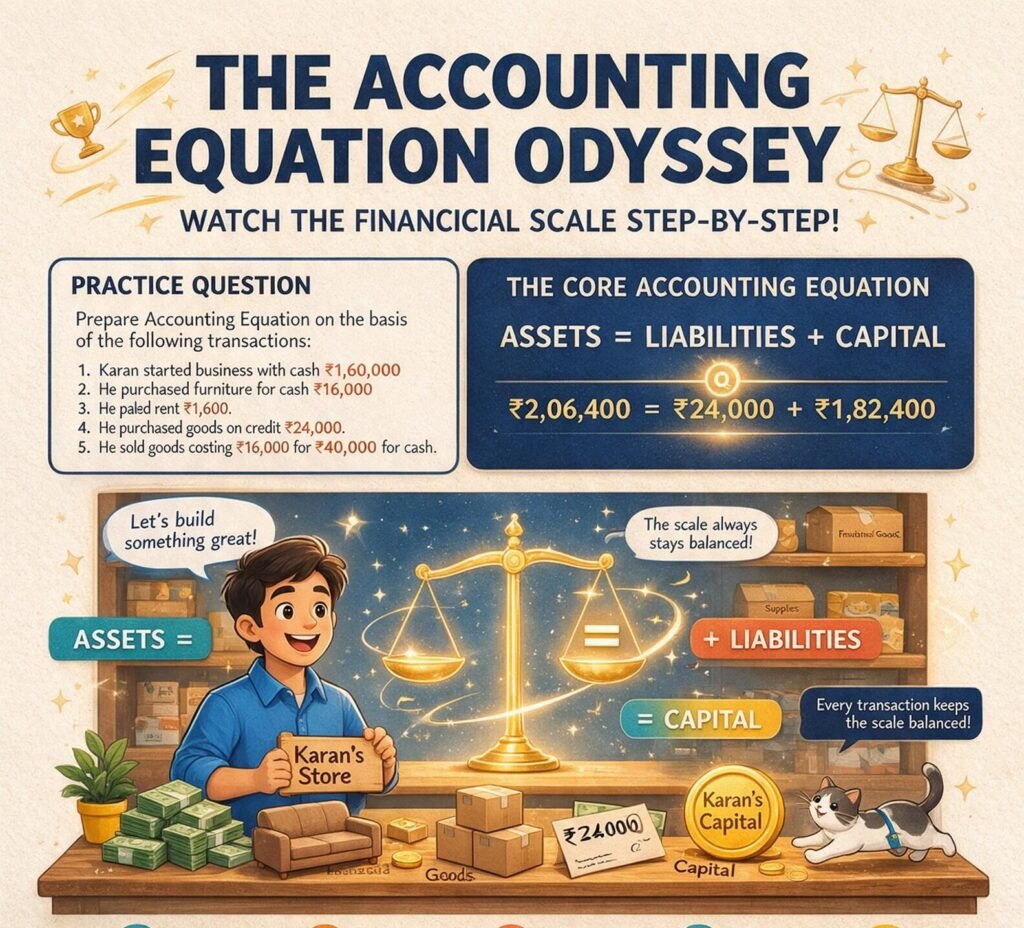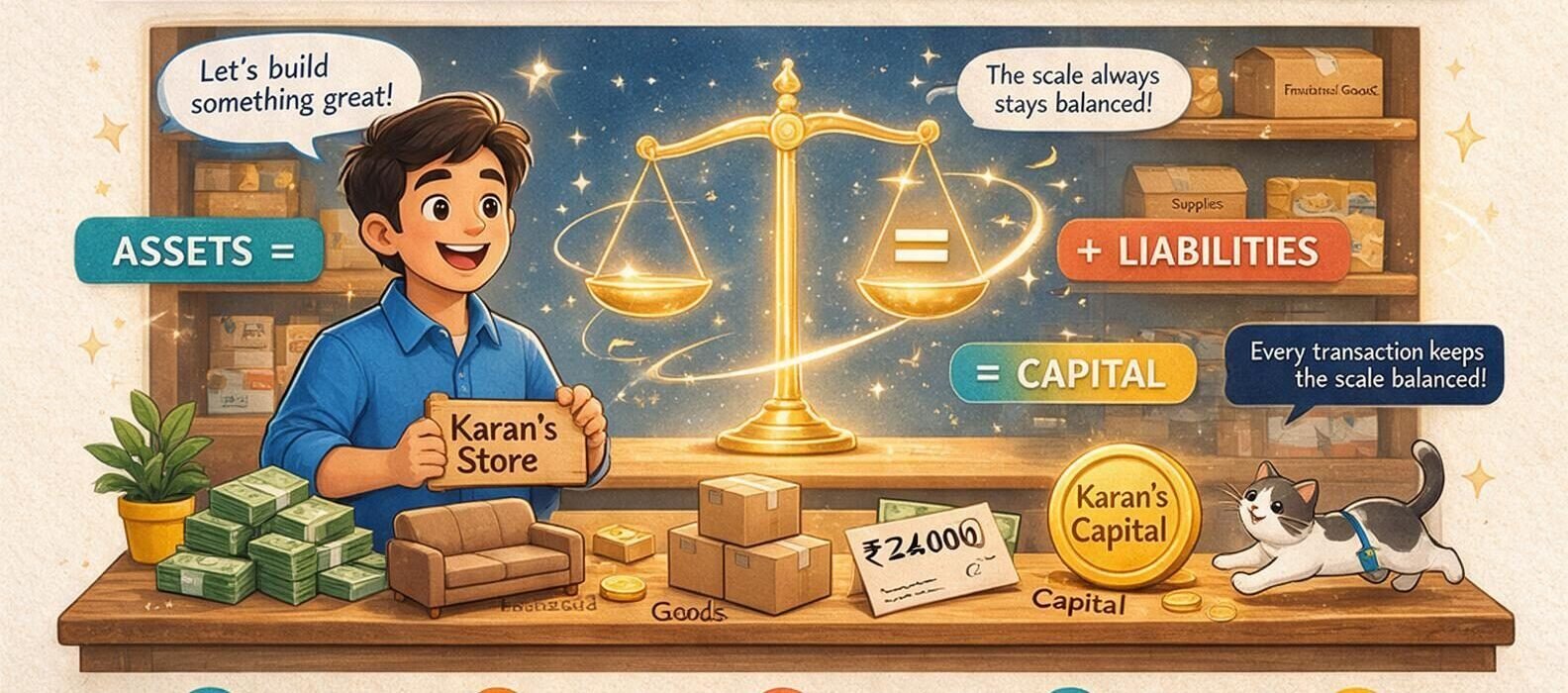
Imagine sitting in the front row at a live movie where every single choice Karan makes for his new business triggers an instant, magical ripple across the financial universe. Accounting isn’t a dusty set of static numbers locked in a spreadsheet—it’s a living, breathing story!
Let’s walk through Karan’s business journey transaction by transaction, breaking down the mechanics so clearly that you’ll feel like you have financial X-ray vision. 🚀
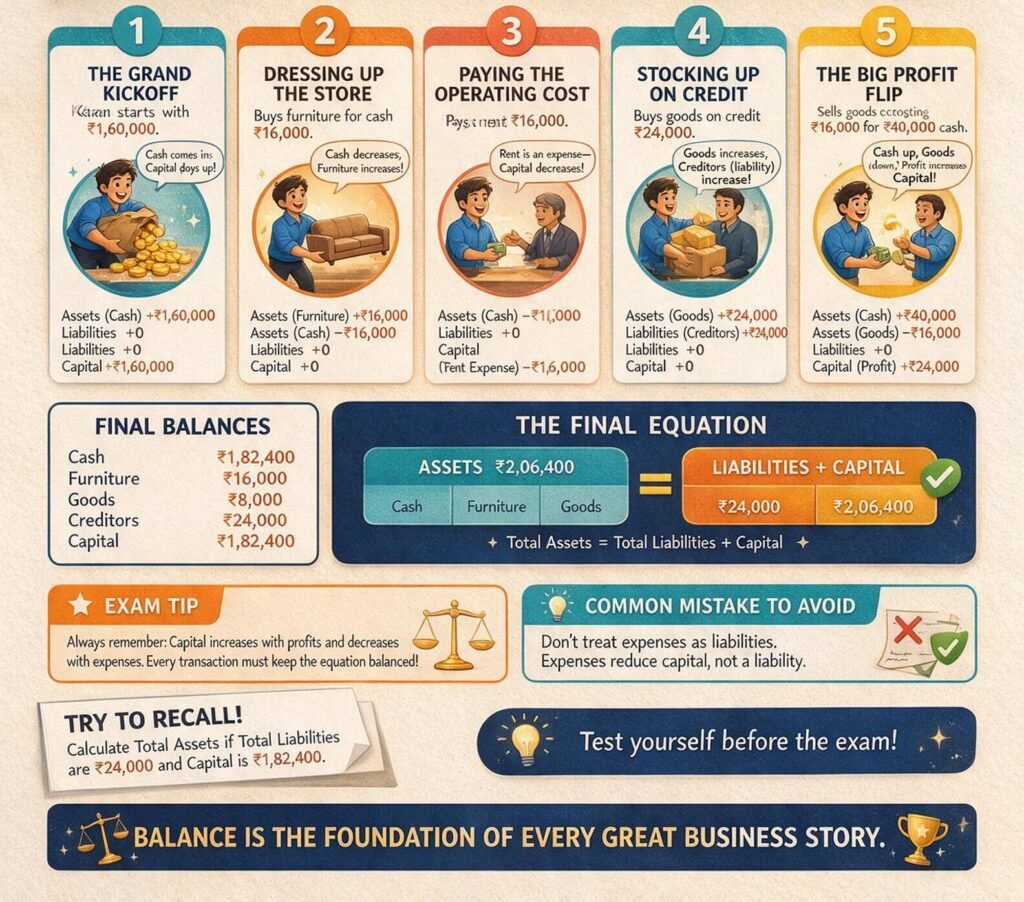
Transaction 1: The Grand Kickoff 💼💵
- The Move: Karan started business with cash of ₹1,60,000.
- Simple Solution Step: Starting the business increases cash and capital by ₹1,60,000.
- The Behind-the-Scenes Secret: Cash flows into the enterprise as an asset, but because of the separate entity rule, the business now officially “owes” that exact amount back to Karan as his starting Capital.
- The Equation Impact:Assets (Cash +1,60,000)=Liabilities (0)+Capital (+1,60,000)
Transaction 2: Dressing Up the Office 🪑🛋️
- The Move: He purchased furniture for cash worth ₹16,000.
- Simple Solution Step: Buying furniture shifts cash into furniture equipment (assets stay balanced internally).
- The Behind-the-Scenes Secret: Money didn’t vanish; it just changed clothes! One liquid asset (Cash) turned into a solid, usable asset (Furniture). Total wealth remains completely untouched.
- The Equation Impact:Assets (Cash −16,000 & Furniture +16,000)=Liabilities (0)+Capital (0)
Transaction 3: Paying the Price of Operations 💡💸
- The Move: He paid rent of ₹1,600.
- Simple Solution Step: Paying rent reduces both cash and capital by ₹1,600.
- The Behind-the-Scenes Secret: Expenses are the unavoidable costs of running a business. When cash flies out to pay the landlord, it’s a resource consumption that directly eats away at the owner’s net equity (Capital).
- The Equation Impact:Assets (Cash −1,600)=Liabilities (0)+Capital (−1,600)
Transaction 4: Stocking Up on Trust 📦🤝
- The Move: He purchased goods on credit worth ₹24,000.
- Simple Solution Step: Purchasing goods on credit increases goods (inventory asset) and creates a creditor (liability) by ₹24,000.
- The Behind-the-Scenes Secret: You don’t always need cash in hand to grow. By taking goods on credit, suppliers trust you with inventory, instantly creating a dual expansion on both sides of the scale.
- The Equation Impact:Assets (Goods +24,000)=Liabilities (Creditors +24,000)+Capital (0)
Transaction 5: The Big Profit Flip 📈💰
- The Move: He sold goods costing ₹16,000 for ₹40,000 for cash.
- Simple Solution Step: Selling goods for cash increases cash by ₹40,000, reduces inventory by ₹16,000, and adds the ₹24,000 profit straight to capital.
- The Behind-the-Scenes Secret: This is where the magic happens! You hand over stock worth ₹16,000, but customers hand you ₹40,000 back. That extra ₹24,000 is pure, unadulterated profit, which belongs entirely to the owner and swells the Capital!
- The Equation Impact:Assets (Cash +40,000 & Goods −16,000)=Liabilities (0)+Capital (Profit +24,000)
Master Transaction Tracking Table 📊
| Transaction Step | Cash (Asset) 🪙 | Furniture (Asset) 🪑 | Goods/Stock (Asset) 📦 | Liabilities (Creditors) 📜 | Capital (Equity) 💎 |
|---|---|---|---|---|---|
| 1. Started Business | +1,60,000 | 0 | 0 | 0 | +1,60,000 |
| 2. Bought Furniture | −16,000 | +16,000 | 0 | 0 | 0 |
| 3. Paid Rent | −1,600 | 0 | 0 | 0 | −1,600 |
| 4. Bought Goods on Credit | 0 | 0 | +24,000 | +24,000 | 0 |
| 5. Sold Goods at Profit | +40,000 | 0 | −16,000 | 0 | +24,000 |
| Final Running Totals | ₹1,82,400 | ₹16,000 | ₹8,000 | ₹24,000 | ₹1,82,400 |
Total Assets (1,82,400 + 16,000 + 8,000 = ₹2,06,400)=Liabilities (24,000)+Capital (1,82,400)=₹2,06,400
🧠⚡ Mind-Blowing Facts to Lock It In Forever
- The Profit Boost: Every time you sell something above its cost price, the difference doesn’t just sit there—it explodes your capital upward. Profit is the ultimate fuel for business expansion!
- Internal vs. External Harmony: Even when you buy inventory on credit (external debt) or shift cash into furniture (internal asset swaps), the cosmic scales of the accounting equation automatically adapt without a single flaw.
- The Ultimate Dopamine Hit: When you sum up all columns and see the left side match the right side down to the exact digit, you realize you’ve just solved the master puzzle of commerce. Total financial clarity unlocked!