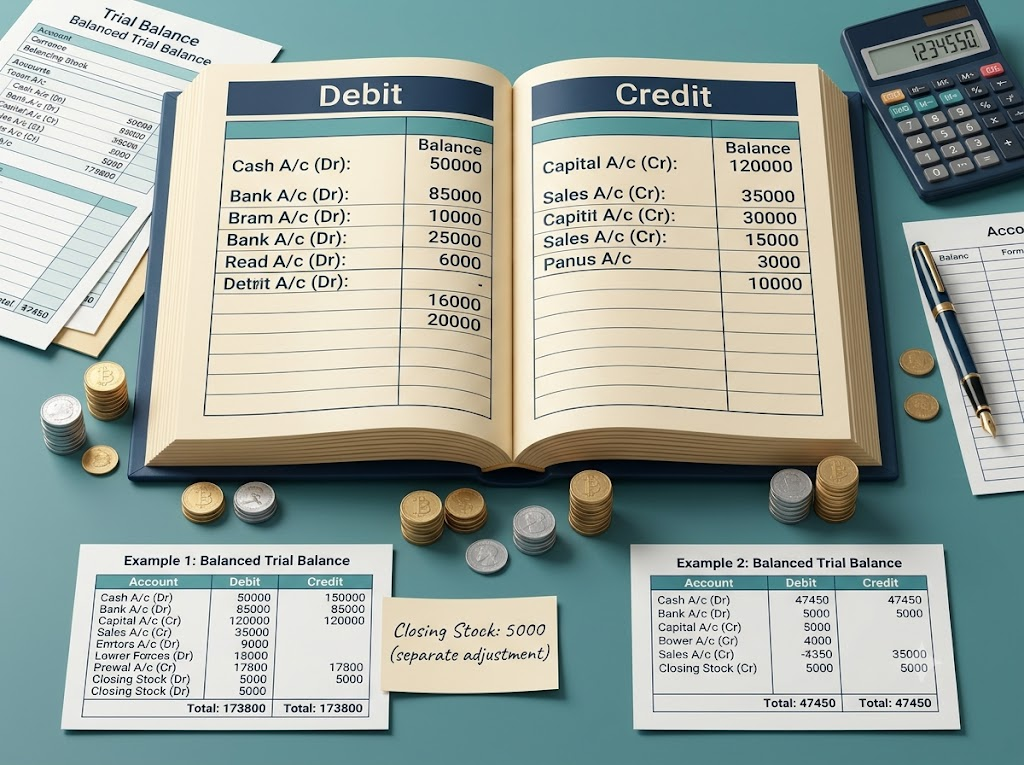
A business has recorded its transactions in the ledger. Now comes the next challenge: bringing the ledger balances together and checking whether the debit and credit totals agree.
Let’s solve two Trial Balance problems step by step.
Case 1: M/s Jai Jawan Jai Kisan Enterprises
Question: Prepare a Trial Balance as on 31 December 2012 from the following balances.
Step 1: Classify the accounts
Assets, expenses, drawings, and opening stock generally have debit balances. Capital, sales and creditors generally have credit balances.
The question also provides Closing Stock of ₹5,000. Closing stock is normally treated as a year-end adjustment when it is given separately, rather than included among the ledger balances in the Trial Balance.
Step 2: Prepare the Trial Balance
M/s Jai Jawan Jai Kisan Enterprises
Trial Balance as on 31 December 2012
| Account | Debit (₹) | Credit (₹) |
|---|---|---|
| Cash in Hand | 31,000 | — |
| Cash at Bank | 12,000 | — |
| Capital Account | — | 80,000 |
| Drawings Account | 28,000 | — |
| Debtors Account | 20,800 | — |
| Creditors Account | — | 17,800 |
| Purchases Account | 62,000 | — |
| Sales Account | — | 76,000 |
| Opening Stock | 10,000 | — |
| Rent Account | 2,000 | — |
| Wages Account | 6,000 | — |
| Carriage Inward Account | 500 | — |
| Machinery Account | 1,500 | — |
| Total | 173,800 | 173,800 |
Step 3: Verify the totals
Debit total:
₹31,000 + ₹12,000 + ₹28,000 + ₹20,800 + ₹62,000 + ₹10,000 + ₹2,000 + ₹6,000 + ₹500 + ₹1,500 = ₹173,800
Credit total:
₹80,000 + ₹17,800 + ₹76,000 = ₹173,800
Both columns agree, so the Trial Balance tallies.
What about Closing Stock of ₹5,000?
Closing Stock has not been included in the table above because it has been treated as a separate year-end adjustment. If the question intends it to be included as a debit balance, the debit total would become ₹178,800, while the credit total would remain ₹173,800. The Trial Balance would then show a difference of ₹5,000.
The original question does not explicitly clarify this treatment, so the textbook’s intended presentation should be checked before the solution is published as definitive.
Case 2: Trial Balance as on 31 March 2013
Question: Prepare a Trial Balance from the following balances.
Step 1: Classify the balances
Cash, bank, furniture, and building are assets and therefore have debit balances. Wages, rent, bank charges and depreciation are expenses and also have debit balances. Capital and sales have credit balances.
Step 2: Prepare the Trial Balance
Trial Balance as on 31 March 2013
| Account | Debit (₹) | Credit (₹) |
|---|---|---|
| Cash in Hand | 3,200 | — |
| Cash at Bank | 12,600 | — |
| Capital Account | — | 27,450 |
| Furniture Account | 12,300 | — |
| Building Account | 15,000 | — |
| Wages Account | 3,500 | — |
| Sales Account | — | 20,000 |
| Rent Account | 250 | — |
| Bank Charges Account | 400 | — |
| Depreciation Account | 200 | — |
| Total | 47,450 | 47,450 |
Step 3: Verify the totals
Debit total:
₹3,200 + ₹12,600 + ₹12,300 + ₹15,000 + ₹3,500 + ₹250 + ₹400 + ₹200 = ₹47,450
Credit total:
₹27,450 + ₹20,000 = ₹47,450
Therefore, the Trial Balance tallies at ₹47,450 on both sides.
The Final Lesson
Preparing a Trial Balance means classifying ledger balances, entering them in the correct columns, adding both columns and comparing the totals. Equal totals indicate arithmetical agreement, but they do not prove that every transaction has been recorded and classified correctly.
Memory line: Classify, total, compare—and remember that a balanced Trial Balance can still hide accounting errors.