
Introduction
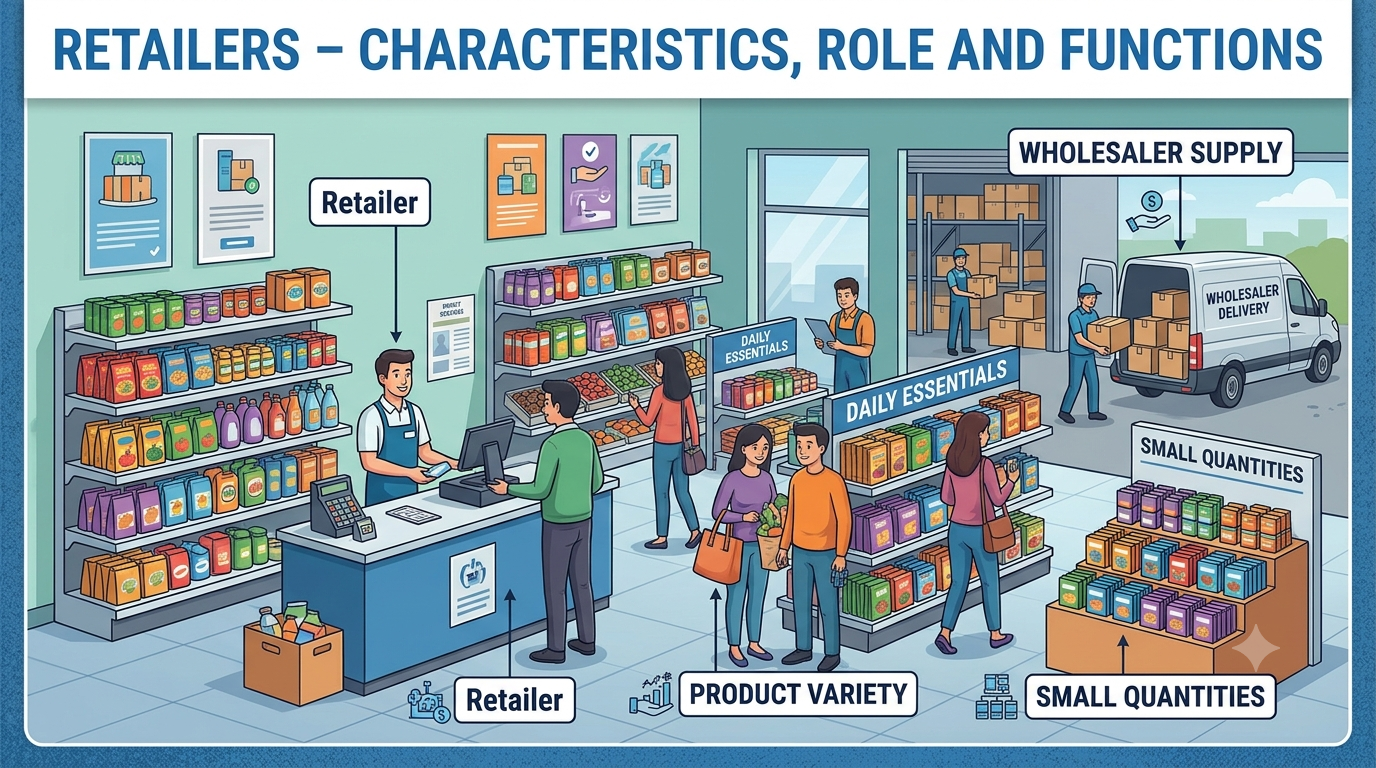
Retailers are the final link in the distribution channel between producers and consumers. They purchase goods from wholesalers or manufacturers and sell them directly to ultimate consumers in small quantities.
Retailers make products easily available to customers through shops, supermarkets, department stores and online platforms.
1. Who Is a Retailer?
A retailer is a person or business organisation that purchases goods from wholesalers or manufacturers and sells them directly to ultimate consumers, generally in small quantities.
Retailers are the final intermediaries in the distribution process.
Example: A grocery shopkeeper purchases rice, oil, soap and other products from wholesalers and sells them to individual customers.
2. Four Characteristics of Retailers
The important characteristics of retailers are as follows:
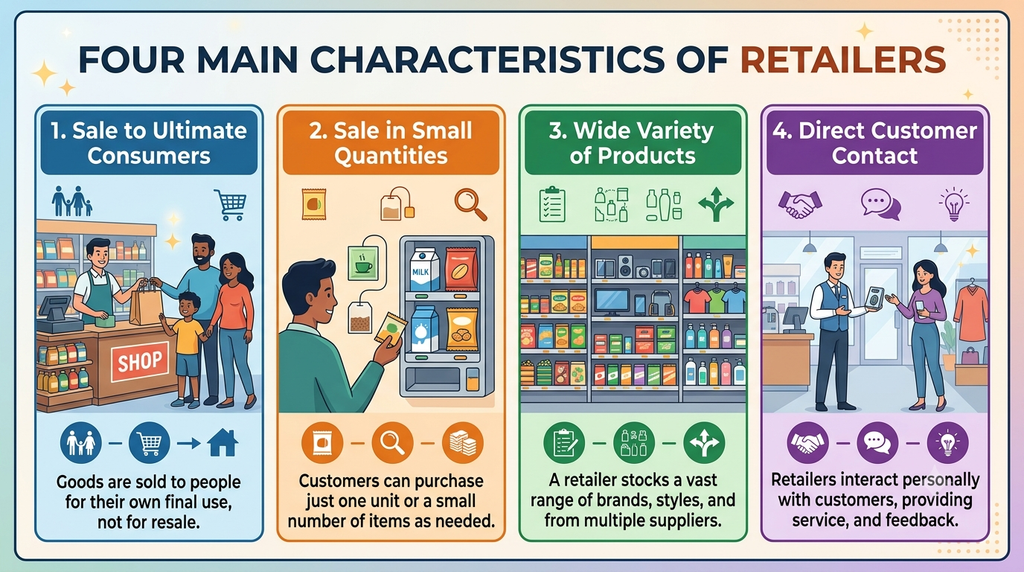
1. Sale to Ultimate Consumers
Retailers generally sell goods directly to the people who use or consume them.
2. Sale in Small Quantities
They purchase goods in larger quantities from wholesalers and sell them in smaller quantities according to customer requirements.
3. Wide Variety of Products
Retailers often keep different types and brands of products to satisfy the needs of various customers.
4. Direct Customer Contact
Retailers have direct contact with customers and understand their preferences, needs and buying habits.
Other Characteristics
- Retailers generally operate through shops, outlets or online platforms.
- They are located near residential or commercial areas to serve customers conveniently.
- They provide information about products and help customers make purchasing decisions.
3. Explain the Role of Retailers in Distribution of Goods
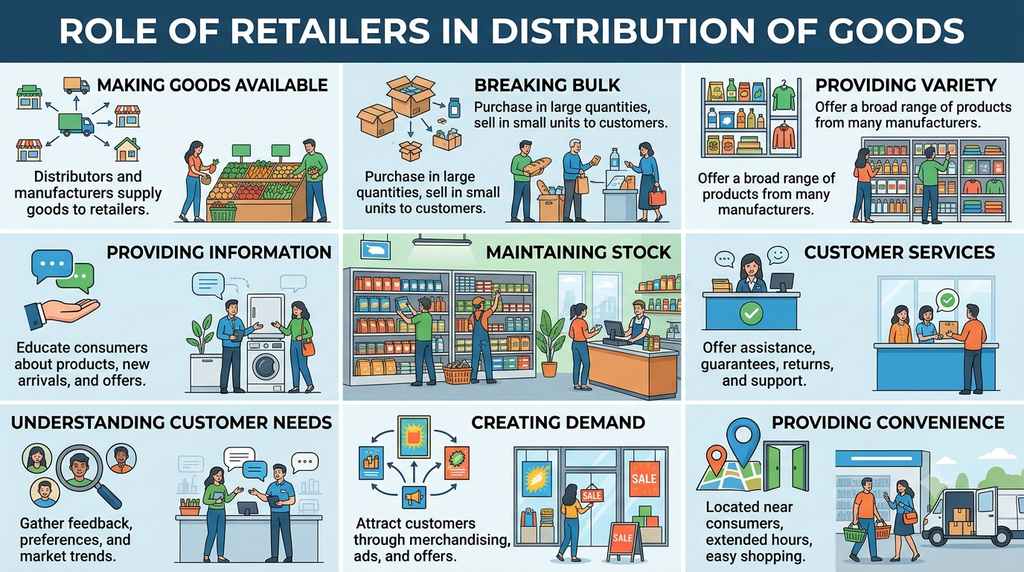
Retailers perform several important activities that help goods reach ultimate consumers.
1. Making Goods Available to Consumers
Retailers make products available at convenient locations so that customers can purchase them easily.
2. Breaking Bulk
Retailers purchase goods in large quantities from wholesalers and sell them in smaller quantities according to customer needs.
Example: A retailer purchases a large bag of rice from a wholesaler and sells it in 1 kg or 5 kg packets.
3. Providing Variety
Retailers keep different brands, sizes, designs and varieties of products so customers can choose according to their preferences.
4. Providing Information
Retailers explain product features, quality, price and uses to customers. This helps customers select suitable products.
5. Maintaining Stock
Retailers maintain stock of different products to meet the regular requirements of customers.
6. Providing Customer Services
Retailers may provide services such as home delivery, product demonstrations, exchanges and after-sales assistance, depending on the nature of the business.
7. Understanding Customer Needs
Since retailers deal directly with consumers, they understand their preferences and buying habits. They can communicate this information to wholesalers and manufacturers.
8. Creating Demand
Retailers display products, explain their benefits and inform customers about new products and offers. These activities encourage purchases.
9. Providing Convenience
Retail shops are generally located near customers, allowing them to purchase goods without travelling long distances.
4. Differences Between Wholesalers and Retailers
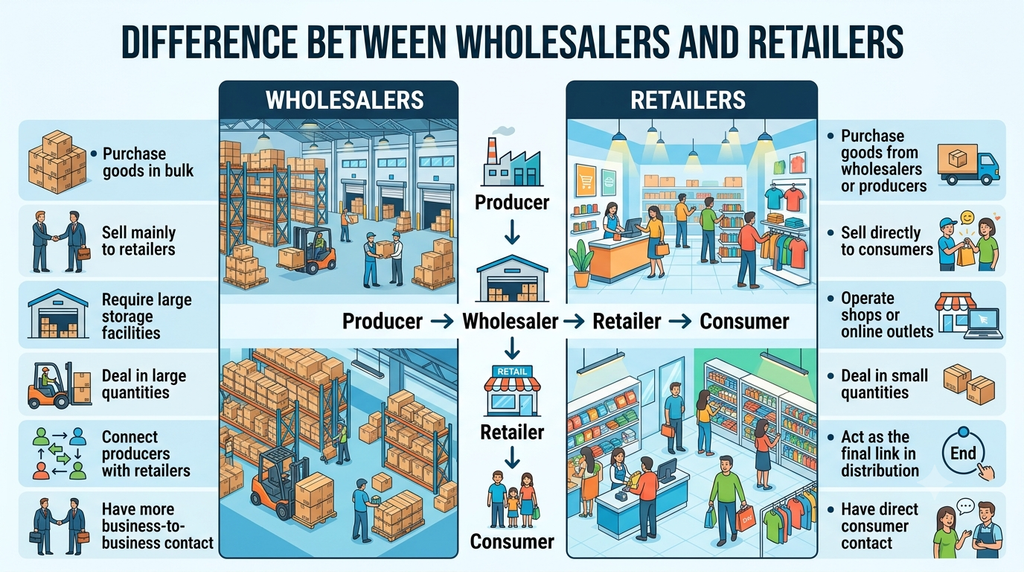
Wholesalers and retailers are both important intermediaries in the distribution channel. However, they differ in their functions and methods of operation.
| Basis | Wholesalers | Retailers |
|---|---|---|
| Meaning | Purchase goods in bulk from producers and sell them to retailers. | Purchase goods from wholesalers or producers and sell them to consumers. |
| Position | They act as a link between producers and retailers. | They are generally the final link between producers and consumers. |
| Customers | Mainly sell to retailers and other business buyers. | Mainly sell to ultimate consumers. |
| Quantity | Deal in large quantities of goods. | Deal in small quantities of goods. |
| Capital | Generally require more capital to purchase and store goods in bulk. | Generally require comparatively less capital than wholesalers. |
| Storage | Usually require large warehouses. | Usually require shops, outlets or smaller storage facilities. |
| Product Variety | Often specialise in particular product categories. | Usually keep a variety of products to meet consumer needs. |
| Customer Contact | Have more contact with retailers. | Have direct contact with ultimate consumers. |
| Market Coverage | May supply goods across several localities or regions. | Generally serve customers in a particular locality or through retail platforms. |
| Risk | Bear risks related to bulk purchasing and storage. | Bear risks related to retail stock, sales and customer demand. |
5. Importance of Retailers in the Distribution System
Retailers are important because they connect the distribution system directly with consumers.
Their importance can be summarised as follows:
- They make products easily available to customers.
- They supply goods in convenient quantities.
- They provide different varieties and brands.
- They help customers select suitable products.
- They maintain regular stocks of goods.
- They provide customer service and convenience.
- They communicate customer preferences to wholesalers and manufacturers.
Conclusion
Retailers are the final link in the channel of distribution. They purchase goods from wholesalers or manufacturers and sell them directly to ultimate consumers. They play an important role by providing product variety, maintaining stock, offering customer services and making goods available in convenient quantities. While wholesalers mainly deal with retailers in bulk quantities, retailers deal directly with consumers in smaller quantities.