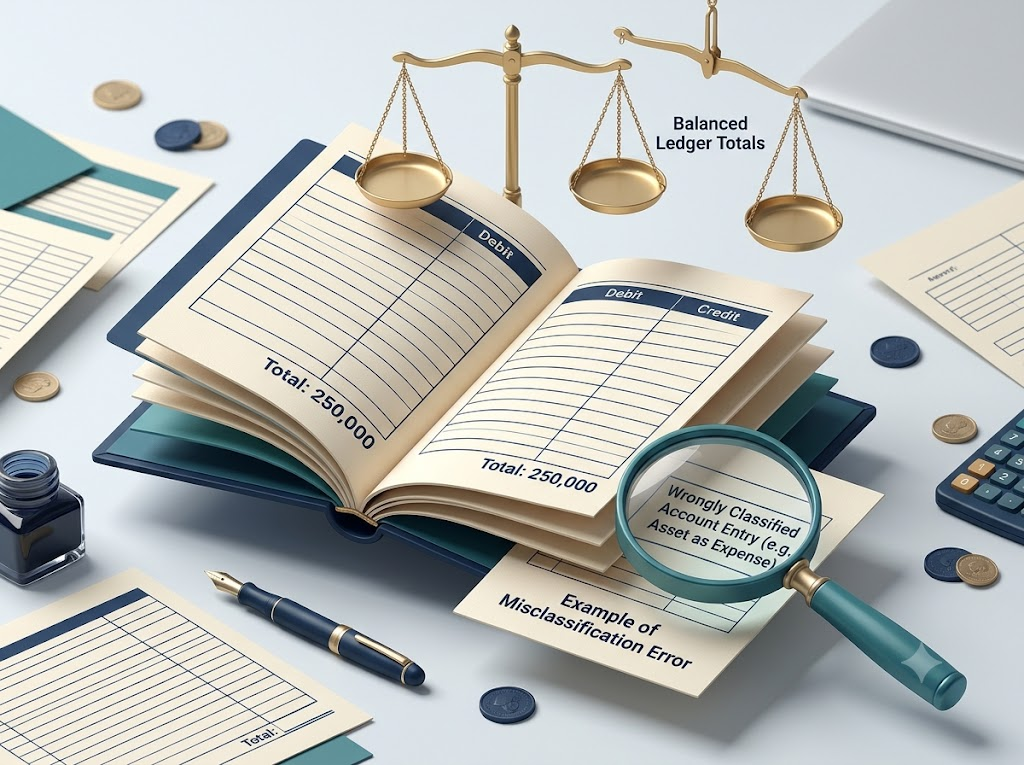
Imagine a shopkeeper has recorded hundreds of transactions. Every purchase, every sale, every payment, and every receipt has found its place in the books. But how can the shopkeeper check whether the debit and credit entries have been recorded with arithmetical accuracy?
Enter the Trial Balance: accounting’s first line of defence against numerical mistakes.
What is a Trial Balance?
A Trial Balance is a statement prepared on a particular date that lists the debit and credit balances of ledger accounts to check whether their totals agree.
Under the double-entry system, every transaction has equal debit and credit effects. Therefore, the total of debit balances should equal the total of credit balances, provided the relevant entries and postings have been made correctly.
Think of the Trial Balance as a balancing scale. If both sides weigh the same, the scale is balanced. But that does not prove that every item has been placed on the correct side or even recorded at all.
Why is the Trial Balance prepared?
The Trial Balance serves several purposes:
- Checking arithmetical accuracy: It checks whether total debit balances equal total credit balances.
- Locating errors: If the totals disagree, it alerts the accountant that an error may have occurred.
- Summarising ledger balances: It brings the balances of different ledger accounts together in one statement.
- Helping prepare financial statements: It provides a starting point for preparing the Trading Account, Profit and Loss Account and Balance Sheet, subject to necessary adjustments.
Which errors can the Trial Balance disclose?
The Trial Balance can reveal errors that cause the debit and credit totals to differ. Examples include:
1. Error in posting one side of an entry
Suppose ₹2,000 paid for rent is correctly credited to the Cash Account, but the Rent Account is debited with only ₹200. The debit and credit effects are unequal, so the Trial Balance may not tally.
2. Posting to the wrong side of an account
Suppose ₹1,000 received from a debtor is correctly credited to the debtor’s account but is also credited, instead of debited, to Cash Account. The debit and credit totals will differ.
3. Incorrect totaling of an account
If a ledger account is added incorrectly, its closing balance may be wrong and cause the Trial Balance totals to disagree.
4. Incorrect balancing or transferring of a balance
If a ledger balance is calculated incorrectly or transferred to the wrong column of the Trial Balance, the totals may not agree.
These are examples of errors that can affect the equality of debit and credit totals. However, not every error produces a difference.
Is the Trial Balance conclusive proof of accuracy?
No. This is one of the most important limitations of the Trial Balance.
A Trial Balance can tally even when the books contain errors. Consider the following cases.
- Complete omission: A transaction is not recorded anywhere in the books.
- Error of principle: An item is recorded in the wrong type of account. For example, the purchase of machinery may be wrongly debited to Purchases Account instead of Machinery Account.
- Error of commission: A transaction is recorded in the wrong account of the same type. For example, a credit sale to Amit is incorrectly posted to Sumit’s account.
- Error of original entry: Both debit and credit entries are recorded with the same incorrect amount.
- Compensating errors: Two or more errors cancel each other’s effects on the Trial Balance totals.
- Complete reversal: The debit and credit sides of a transaction are interchanged.
Why do these errors escape detection? Because the total debits can still equal total credits even though the transactions have been recorded incorrectly.
For instance, if furniture worth ₹5,000 is wrongly debited to Purchases Account, the debit side remains ₹5,000, and the credit side remains ₹5,000. The Trial Balance may still tally, although the account classification is wrong.
Limitations of the Trial Balance
The Trial Balance:
- Cannot detect every error in the books of account.
- Cannot prove that every transaction has been recorded.
- Cannot establish that transactions have been entered in the correct accounts.
- Cannot, by itself, establish the complete accuracy of the ledger or the financial statements.
Exam-ready takeaway: The Trial Balance is a test of arithmetical accuracy, not conclusive proof of the complete accuracy of the books of account.