
Introduction
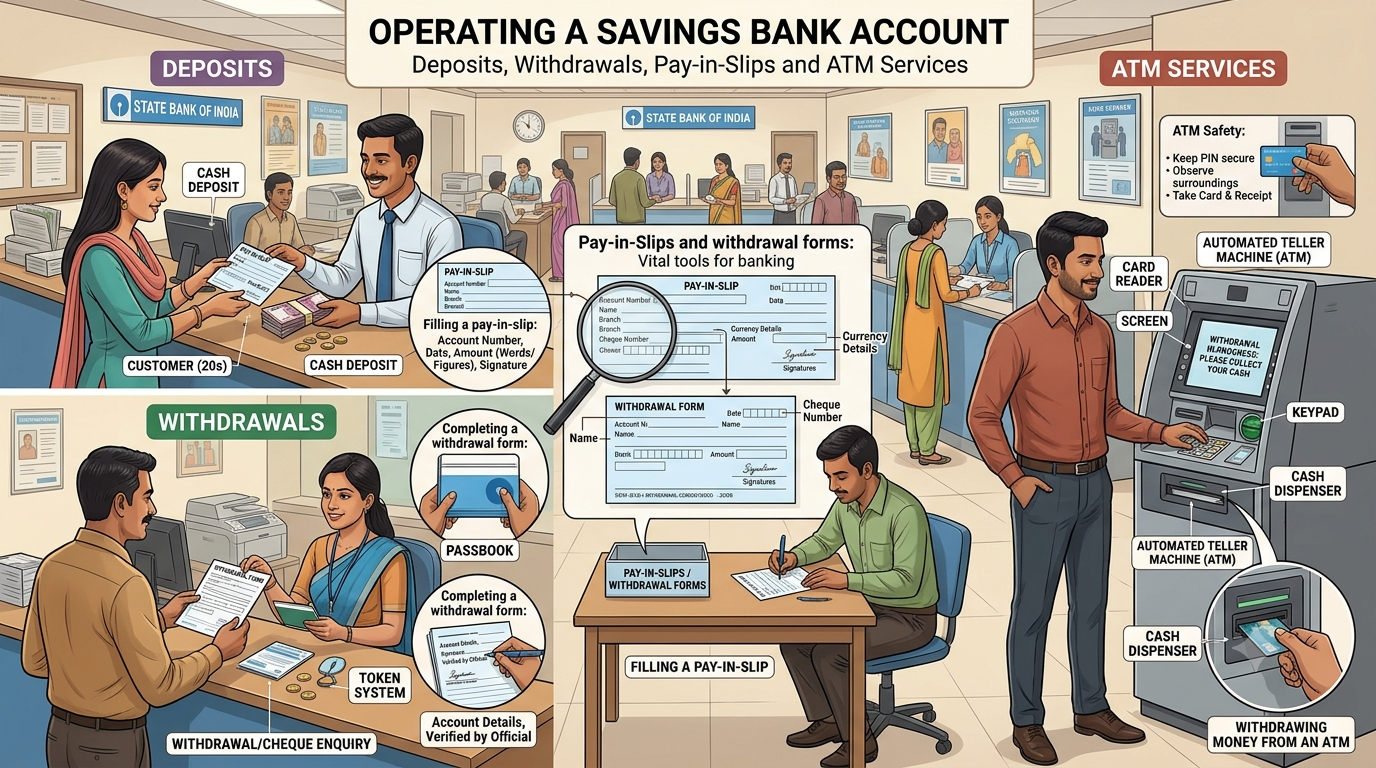
After opening a savings bank account, customers can deposit money and withdraw it whenever required, subject to the account’s terms and available balance.
Banks provide different methods for depositing and withdrawing money. These include cash deposits, cheque deposits, withdrawal forms, cheques, debit cards and ATMs.
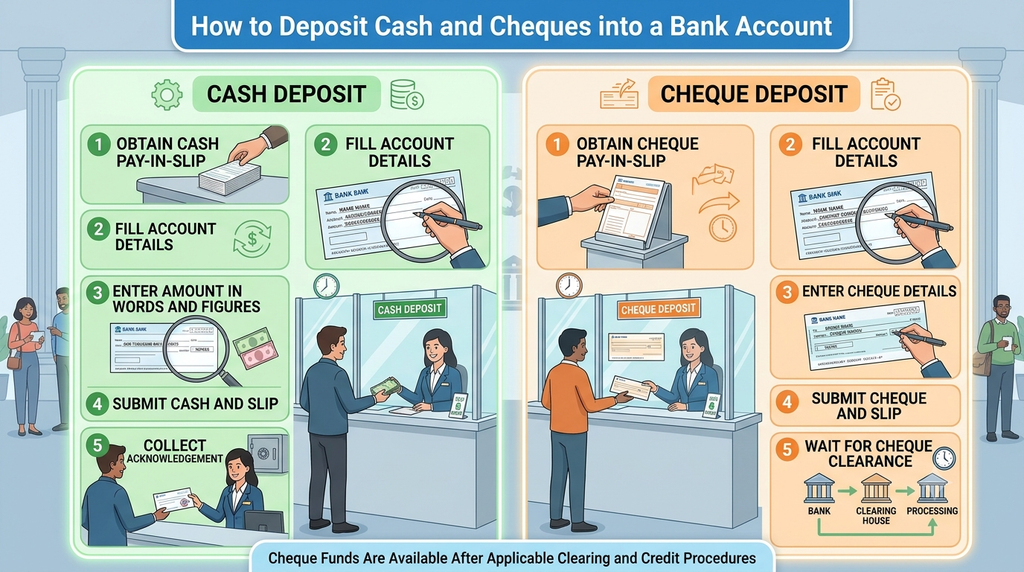
1. Procedure for Depositing Cash into a Savings Account
A customer can deposit cash at the bank branch by following these steps:
- Obtain a cash deposit pay-in-slip from the bank.
- Fill in the account holder’s name and account number.
- Write the date and amount to be deposited.
- Enter the amount in words and figures.
- Mention the denomination details, if required.
- Sign the slip, where required.
- Submit the pay-in-slip along with the cash at the appropriate counter.
- Collect the stamped or acknowledged customer copy as proof of deposit.
2. Procedure for Depositing a Cheque
A customer can deposit a cheque into a savings account by following these steps:
- Obtain a cheque deposit pay-in-slip.
- Fill in the account holder’s name and account number.
- Enter the cheque number, date, amount and bank details.
- Write the amount in words and figures.
- Mention the drawer’s bank details, where required.
- Submit the cheque and completed slip at the bank counter or use the designated cheque drop facility.
- Keep the acknowledgement, if provided.
- The amount is credited after the cheque is processed and cleared.
Important: A cheque deposit does not mean that the money becomes immediately available. The customer can use the funds according to the bank’s clearing and credit rules.
3. Meaning and Utility of a Pay-in-Slip
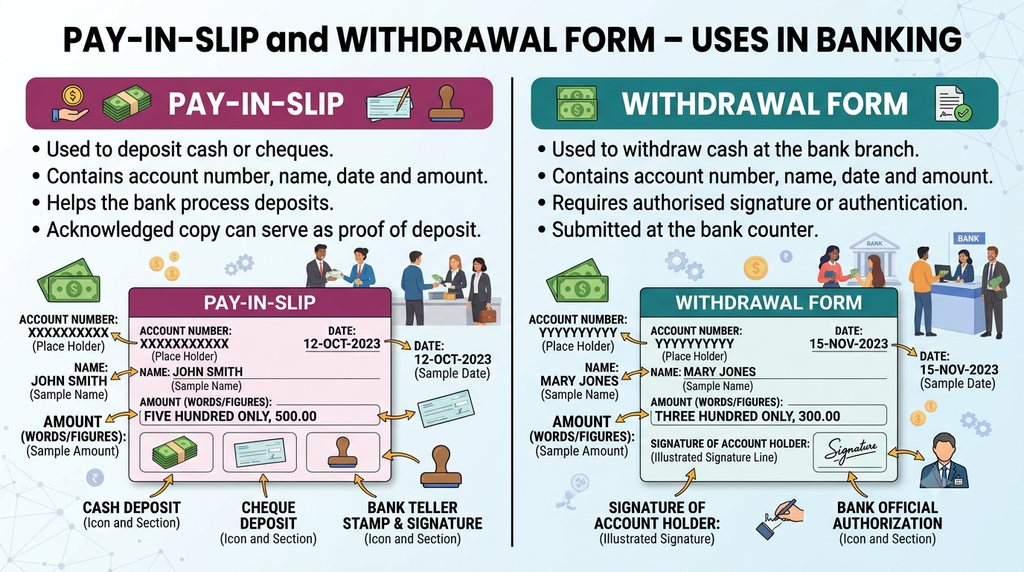
A pay-in-slip is a form used by a bank customer to provide details when depositing cash or cheques into a bank account.
Uses of a Pay-in-Slip
- It identifies the account into which money is being deposited.
- It records the amount deposited.
- It provides details of cash or cheques deposited.
- It helps the bank process the deposit.
- The acknowledged copy can serve as proof of deposit.
4. Meaning and Use of a Withdrawal Form
A withdrawal form is a bank form used by an account holder to withdraw money from an account at the bank branch.
It is generally used when the customer does not use a cheque or another withdrawal method.
Particulars on a Withdrawal Form
A withdrawal form may require:
- Account number.
- Account holder’s name.
- Date.
- Amount to be withdrawn.
- Signature or other authorised authentication.
The customer submits the completed form according to the bank’s procedure and receives cash after verification.
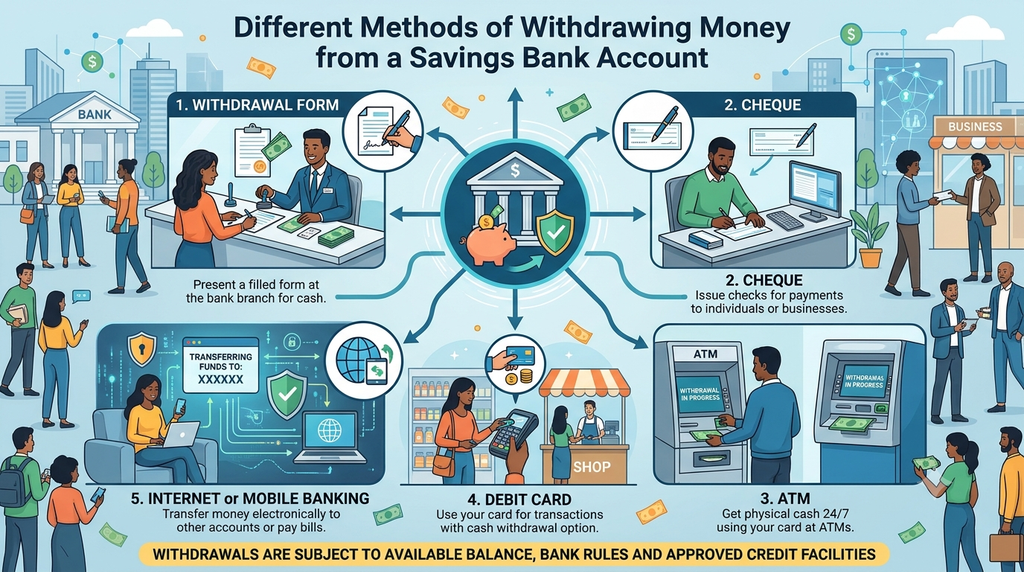
5. Different Methods of Withdrawing Money from a Savings Account
Customers can withdraw money through different methods.
A. Withdrawal Form
The account holder fills in a withdrawal form and submits it at the bank counter.
B. Cheque
The account holder writes a cheque for the required amount and presents it for payment or deposits it into another account.
C. ATM
The customer uses an ATM card and PIN to withdraw cash from an ATM.
D. Debit Card
A debit card can be used to withdraw cash at ATMs and make payments at authorised outlets.
E. Internet or Mobile Banking
Customers can transfer money to another account using authorised digital banking services. This is a transfer rather than a cash withdrawal at the branch.
6. Can You Withdraw More Than the Balance in a Savings Account?
Generally, a customer cannot withdraw more money than the available balance in a normal savings account.
This is because the bank permits withdrawals only up to the available balance, subject to applicable rules and limits.
However, an overdraft or another approved credit facility may allow an eligible customer to withdraw or use additional funds. Such a facility is not automatically available with every savings account.
7. Precautions While Operating a Savings Account
- Keep your passbook and account details safe.
- Check the amount before submitting a deposit slip.
- Verify cheque details before depositing.
- Collect and preserve deposit acknowledgements.
- Never share your ATM PIN or OTP.
- Check account statements regularly.
- Report unauthorised transactions to the bank immediately.
Conclusion
A savings bank account can be operated through several convenient methods. Pay-in-slips are used for cash and cheque deposits, while withdrawal forms, cheques, ATMs and digital banking services help customers access their money.