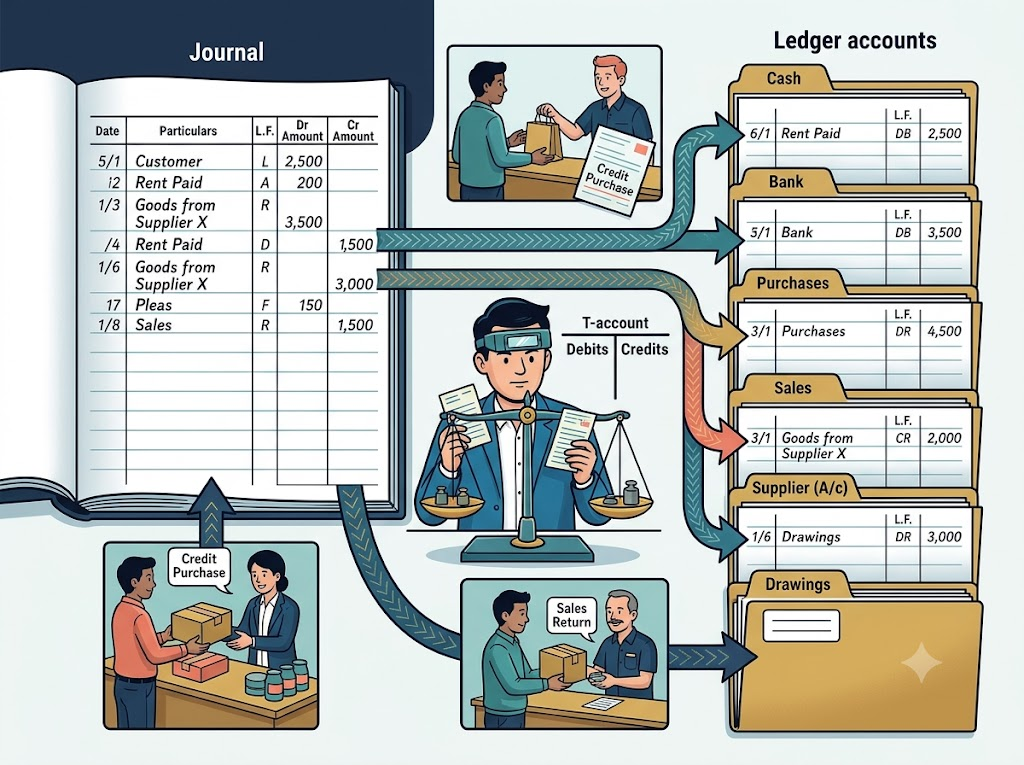
A business records more than sales and purchases. It must track cash, bank balances, customers who owe money, suppliers who need payment, expenses, and the owner’s personal withdrawals. The Journal records each transaction, while the Ledger groups transactions into separate accounts.
In this practical guide, four businesses face different accounting challenges. Follow each transaction from the Journal to the Ledger, and see how the final balances are calculated.
Case 1: A Business Begins in April 2012
A new business starts with cash and then makes purchases, deposits money into the bank, and earns sales revenue.
Journal entries
| Date | Particulars | Debit (₹) | Credit (₹) |
|---|---|---|---|
| Apr. 1 | Cash A/c Dr. | 1,00,000 | — |
| To Capital A/c | — | 1,00,000 | |
| Apr. 3 | Bank A/c Dr. | 30,000 | — |
| To Cash A/c | — | 30,000 | |
| Apr. 5 | Furniture A/c Dr. | 5,000 | — |
| To Cash A/c | — | 5,000 | |
| Apr. 8 | Purchases A/c Dr. | 15,000 | — |
| To Bank A/c | — | 15,000 | |
| Apr. 14 | Purchases A/c Dr. | 35,000 | — |
| To Hari A/c | — | 35,000 | |
| Apr. 18 | Cash A/c Dr. | 32,000 | — |
| To Sales A/c | — | 32,000 | |
| Total | 2,17,000 | 2,17,000 |
The business deposits ₹30,000 into the bank, purchases furniture for ₹5,000 in cash, buys goods worth ₹15,000 by cheque,e and purchases goods worth ₹35,000 from Hari on credit. It later makes cash sales of ₹32,000.
Notice the difference between the two purchases: the cheque payment credits Bank A/c, while the credit purchase credits Hari A/c because the supplier is owed money.
Ledger balances
Cash Account
| Debit side | Amount (₹) | Credit side | Amount (₹) |
|---|---|---|---|
| To Capital A/c | 1,00,000 | By Bank A/c | 30,000 |
| To Sales A/c | 32,000 | By Furniture A/c | 5,000 |
| By Balance c/d | 97,000 | ||
| Total | 1,32,000 | Total | 1,32,000 |
Cash balance = ₹1,32,000 − ₹35,000 = ₹97,000 debit balance.
Bank Account
| Debit side | Amount (₹) | Credit side | Amount (₹) |
|---|---|---|---|
| To Cash A/c | 30,000 | By Purchases A/c | 15,000 |
| By Balance c/d | 15,000 | ||
| Total | 30,000 | Total | 30,000 |
Bank balance = ₹30,000 − ₹15,000 = ₹15,000 debit balance.
Other Ledger balances
| Account | Balance before closing |
|---|---|
| Furniture A/c | ₹5,000 Dr. |
| Purchases A/c | ₹50,000 Dr. |
| Hari A/c | ₹35,000 Cr. |
| Capital A/c | ₹1,00,000 Cr. |
| Sales A/c | ₹32,000 Cr. |
At the end of the accounting period, Purchases and Sales balances are transferred to the Trading Account under the usual method. They are not carried forward like Cash and Bank balances.
Case 2: Rathore’s Business — Returns, Insolvency and Drawings
This case includes charity, credit purchases, income received, goods returned, ed and a debtor who cannot pay the full amount owed.
Important clarification about the opening balances
The question lists these opening balances on January 1:
- Cash in hand: ₹1,50,000
- Goods in hand: ₹80,000
- Outstanding wages: ₹20,000
Using only these listed items, opening capital would be ₹2,10,000:
Assets = ₹1,50,000 + ₹80,000 = ₹2,30,000.
Capital = Assets − Liabilities = ₹2,30,000 − ₹20,000 = ₹2,10,000.
However, the question later states that Ram owes ₹4,000. Because the transaction creating this debt is not provided, the original question may have omitted Ram from the opening balances.
For the following worked solution, we assume Ram’s ₹4,000 debt existed on January 1. It must therefore be included as an opening asset.
Total assets = ₹1,50,000 + ₹80,000 + ₹4,000 = ₹2,34,000.
Capital = ₹2,34,000 − ₹20,000 = ₹2,14,000.
Opening Journal Entry
| Particulars | Debit (₹) | Credit (₹) |
|---|---|---|
| Cash A/c Dr. | 1,50,000 | — |
| Stock A/c Dr. | 80,000 | — |
| Ram A/c Dr. | 4,000 | — |
| To Outstanding Wages A/c | — | 20,000 |
| To Capital A/c | — | 2,14,000 |
| Total | 2,34,000 | 2,34,000 |
Journal entries for January
| Date | Particulars | Debit (₹) | Credit (₹) |
|---|---|---|---|
| Jan. 4 | Charity A/c Dr. | 501 | — |
| To Cash A/c | — | 501 | |
| Jan. 4 | Purchases A/c Dr. | 20,000 | — |
| To Akash A/c | — | 20,000 | |
| Jan. 5 | Cash A/c Dr. | 5,000 | — |
| To Rent Received A/c | — | 5,000 | |
| Jan. 18 | Akash A/c Dr. | 17,000 | — |
| To Cash A/c | — | 17,000 | |
| Jan. 22 | Cash A/c Dr. | 1,750 | — |
| To Interest Received A/c | — | 1,750 | |
| Jan. 24 | Sales Returns A/c Dr. | 1,250 | — |
| To Magan A/c | — | 1,250 | |
| Jan. 26 | Akash A/c Dr. | 2,000 | — |
| To Purchase Returns A/c | — | 2,000 | |
| Jan. 29 | Cash A/c Dr. | 1,600 | — |
| Bad Debts A/c Dr. | 2,400 | — | |
| To Ram A/c | — | 4,000 | |
| Jan. 31 | Drawings A/c Dr. | 42,000 | — |
| To Cash A/c* | — | 42,000 |
The last entry assumes the motorcycle was paid for in cash. If it was paid for through the bank, Bank A/c should be credited instead.
Understanding the important entries
Goods returned by Magan: Sales Returns A/c is debited, and Magan A/c is credited. This reduces the amount receivable from Magan.
Goods returned to Akash: Akash A/c is debited to reduce the amount payable to the supplier, and Purchase Returns A/c is credited.
Ram becomes insolvent: Ram owes ₹4,000 but pays only 40 paise per rupee.
Amount received = ₹4,000 × 40% = ₹1,600.
Bad debt = ₹4,000 − ₹1,600 = ₹2,400.
Cash is debited for ₹1,600, Bad Debts A/c is debited for ₹2,400, and Ram A/c is credited for ₹4,000 to close the debt.
Motor-cycle purchased for Rathore’s son: Because it is for personal use, it is recorded as Drawings, not as a business asset.
Ledger balances
| Account | Balance |
|---|---|
| Cash A/c | ₹98,849 Dr. |
| Stock A/c | ₹80,000 Dr. |
| Ram A/c | Nil after settlement |
| Akash A/c | ₹1,000 Cr. |
| Charity A/c | ₹501 Dr. |
| Purchases A/c | ₹20,000 Dr. |
| Rent Received A/c | ₹5,000 Cr. |
| Interest Received A/c | ₹1,750 Cr. |
| Sales Returns A/c | ₹1,250 Dr. |
| Purchase Returns A/c | ₹2,000 Cr. |
| Bad Debts A/c | ₹2,400 Dr. |
| Drawings A/c | ₹42,000 Dr. |
| Outstanding Wages A/c | ₹20,000 Cr. |
| Capital A/c | ₹2,14,000 Cr. |
Cash balance:
₹1,50,000 − ₹501 + ₹5,000 − ₹17,000 + ₹1,750 + ₹1,600 − ₹42,000 = ₹98,849.
Akash’s balance:
₹20,000 − ₹17,000 − ₹2,000 = ₹1,000 credit balance.
The opening capital of ₹2,14,000 is correct only under the stated assumption that Ram’s debt was an opening asset. If Ram’s debt was not outstanding on January 1, the original question needs clarification before a definitive opening entry can be prepared.
Case 3: Krishna’s Business — Credit Transactions and Discount Allowed
Krishna’s business has opening assets, an existing creditor and bills payable. During July, it purchases goods on credit, sells to customers, receives a cheque with a discount allowed, and pays expenses.
Opening capital
Opening debit balances:
- Cash: ₹2,000
- Bank: ₹12,000
- Ashok (debtor): ₹2,500
- Stock: ₹10,000
Total debit balances = ₹26,500.
Opening credit balances:
- Bills Payable: ₹4,000
- Charu (creditor): ₹2,000
Total credit balances other than capital = ₹6,000.
Assuming the list is complete:
Capital = ₹26,500 − ₹6,000 = ₹20,500.
Journal entries
| Date | Particulars | Debit (₹) | Credit (₹) |
|---|---|---|---|
| July 1 | Cash A/c Dr. | 2,000 | — |
| Bank A/c Dr. | 12,000 | — | |
| Ashok A/c Dr. | 2,500 | — | |
| Stock A/c Dr. | 10,000 | — | |
| To Bills Payable A/c | — | 4,000 | |
| To Charu A/c | — | 2,000 | |
| To Capital A/c | — | 20,500 | |
| July 1 | Purchases A/c Dr. | 10,000 | — |
| To Charu A/c | — | 10,000 | |
| July 2 | Surinder A/c Dr. | 21,000 | — |
| To Sales A/c | — | 21,000 | |
| July 3 | Purchases A/c Dr. | 16,000 | — |
| To Ram Lakhan A/c | — | 16,000 | |
| July 6 | Paresha A/c Dr. | 8,000 | — |
| To Sales A/c | — | 8,000 | |
| July 12 | Charu A/c Dr. | 16,000 | — |
| To Bank A/c | — | 16,000 | |
| July 20 | Bank A/c Dr. | 8,900 | — |
| Discount Allowed A/c Dr. | 100 | — | |
| To Surinder A/c | — | 9,000 | |
| July 24 | Surinder A/c Dr. | 18,000 | — |
| To Sales A/c | — | 18,000 | |
| July 25 | Rent A/c Dr. | 2,000 | — |
| To Bank A/c | — | 2,000 | |
| July 25 | Paresha A/c Dr. | 15,000 | — |
| To Sales A/c | — | 15,000 | |
| July 31 | Salaries A/c Dr. | 5,000 | — |
| To Cash A/c* | — | 5,000 |
The question says salaries were paid but does not specify whether payment was made in cash or through the bank. The payment method must be confirmed because it affects the closing balances.
Understanding the discount
On July 20, Krishna receives ₹8,900 by cheque from Surinder and allows him a discount of ₹100.
Total amount settled = ₹8,900 + ₹100 = ₹9,000.
Surinder A/c is credited by ₹9,000 because his outstanding debt is reduced by that amount. Bank A/c is debited by ₹8,900, and Discount Allowed A/c is debited by ₹100.
Ledger balances
Customer accounts
| Account | Calculation | Balance |
|---|---|---|
| Surinder A/c | ₹21,000 − ₹9,000 + ₹18,000 | ₹30,000 Dr. |
| Paresha A/c | ₹8,000 + ₹15,000 | ₹23,000 Dr. |
| Ashok A/c | Opening debtor | ₹2,500 Dr. |
Supplier and other accounts
| Account | Calculation | Balance |
|---|---|---|
| Charu A/c | ₹2,000 opening credit + ₹10,000 purchase − ₹16,000 payment | ₹4,000 Dr. |
| Ram Lakhan A/c | Credit purchase | ₹16,000 Cr. |
| Bills Payable A/c | Opening liability | ₹4,000 Cr. |
| Stock A/c | Opening balance only | ₹10,000 Dr. |
| Purchases A/c | ₹10,000 + ₹16,000 | ₹26,000 Dr. |
| Sales A/c | ₹21,000 + ₹8,000 + ₹18,000 + ₹15,000 | ₹62,000 Cr. |
| Discount Allowed A/c | Discount to Surinder | ₹100 Dr. |
| Rent A/c | Rent paid | ₹2,000 Dr. |
| Salaries A/c | Salaries paid | ₹5,000 Dr. |
| Capital A/c | Opening capital | ₹20,500 Cr. |
Cash and Bank balances depend on the salary payment method.
- If salaries were paid in cash, Cash A/c would be ₹3,000 credit: ₹2,000 − ₹5,000. This indicates an inconsistency in the supplied information because the available opening cash is insufficient.
- If salaries were paid by bank, Cash A/c would remain ₹2,000 debit, while Bank A/c would have a ₹2,100 credit balance: ₹12,000 + ₹8,900 − ₹16,000 − ₹2,000 − ₹5,000 = −₹2,100.
The second possibility produces a bank overdraft, but the question does not state that an overdraft exists. The original source should therefore be checked rather than silently selecting one payment method.
Charu’s account has a ₹4,000 debit balance because the payment of ₹16,000 exceeds the listed amount due of ₹12,000. Based on the figures supplied, this is an advance to the supplier unless other balances or transactions have been omitted.
Case 4: Garib Chand and Sons — Credit Sales and Drawings
This business begins in April with cash, stock, a bank balance, a debtor, and an amount payable to a supplier.
Opening capital
Opening debit balances:
Cash ₹11,500 + Stock ₹12,500 + Bank ₹20,000 + Tara Chandani ₹2,000 = ₹46,000.
Opening liability to Ramesh = ₹1,000.
Capital = Assets − Liabilities = ₹46,000 − ₹1,000 = ₹45,000, assuming the opening list is complete.
Opening Journal Entry
| Particulars | Debit (₹) | Credit (₹) |
|---|---|---|
| Cash A/c Dr. | 11,500 | — |
| Stock A/c Dr. | 12,500 | — |
| Bank A/c Dr. | 20,000 | — |
| Tara Chandani A/c Dr. | 2,000 | — |
| To Ramesh A/c | — | 1,000 |
| To Capital A/c | — | 45,000 |
| Total | 46,000 | 46,000 |
Journal entries for April
| Date | Particulars | Debit (₹) | Credit (₹) |
|---|---|---|---|
| Apr. 2 | Manmohan A/c Dr. | 15,000 | — |
| To Sales A/c | — | 15,000 | |
| Apr. 4 | Cash A/c Dr. | 7,000 | — |
| To Sales A/c | — | 7,000 | |
| Apr. 7 | Raghuvanshi A/c Dr. | 4,000 | — |
| To Sales A/c | — | 4,000 | |
| Apr. 9 | Purchases A/c Dr. | 1,250 | — |
| To Ramesh A/c | — | 1,250 | |
| Apr. 15 | Tara Chandani A/c Dr. | 2,000 | — |
| To Sales A/c | — | 2,000 | |
| Apr. 18 | Wages A/c Dr. | 400 | — |
| To Cash A/c | — | 400 | |
| Apr. 21 | Cash A/c Dr. | 6,000 | — |
| To Manmohan A/c | — | 6,000 | |
| Apr. 28 | Drawings A/c Dr. | 1,000 | — |
| To Purchases A/c | — | 1,000 | |
| Apr. 30 | Drawings A/c Dr. | 5,000 | — |
| To Cash A/c* | — | 5,000 |
The final entry assumes the income-tax payment was made in cash. If it was paid through the bank, Bank A/c should be credited instead.
Ledger balances
Cash Account — assuming income tax was paid in cash
| Debit side | Amount (₹) | Credit side | Amount (₹) |
|---|---|---|---|
| Balance b/d | 11,500 | By Wages A/c | 400 |
| To Sales A/c | 7,000 | By Drawings A/c | 5,000 |
| To Manmohan A/c | 6,000 | By Balance c/d | 19,100 |
| Total | 24,500 | Total | 24,500 |
Closing cash balance = ₹11,500 + ₹7,000 + ₹6,000 − ₹400 − ₹5,000 = ₹19,100 debit.
If income tax was paid through the bank instead, Cash A/c would close at ₹24,100 debit, and Bank A/c would close at ₹15,000 debit.
Customer accounts
| Account | Calculation | Balance |
|---|---|---|
| Manmohan A/c | ₹15,000 sale − ₹6,000 received | ₹9,000 Dr. |
| Raghuvanshi A/c | Credit sale | ₹4,000 Dr. |
| Tara Chandani A/c | ₹2,000 opening debt + ₹2,000 sale | ₹4,000 Dr. |
Supplier and other accounts
| Account | Calculation | Balance |
|---|---|---|
| Ramesh A/c | ₹1,000 opening credit + ₹1,250 purchase | ₹2,250 Cr. |
| Purchases A/c | ₹1,250 − ₹1,000 goods withdrawn | ₹250 Dr. before closing |
| Sales A/c | ₹15,000 + ₹7,000 + ₹4,000 + ₹2,000 | ₹28,000 Cr. |
| Wages A/c | Wages paid | ₹400 Dr. |
| Drawings A/c | ₹1,000 goods + ₹5,000 personal income tax | ₹6,000 Dr. |
| Stock A/c | Opening balance only | ₹12,500 Dr. |
| Capital A/c | Opening capital | ₹45,000 Cr. |
Goods taken by the proprietor for personal use are recorded by debiting Drawings A/c and crediting Purchases A/c under the usual periodic Purchases Account method. Personal income tax paid from business funds is also treated as Drawings, not as a business operating expense.
The Rules Behind All Four Cases
- Assets and expenses generally have debit balances.
- Capital, liabilities and income generally have credit balances.
- Credit sales: Debit the customer’s account and credit Sales A/c.
- Credit purchases: Debit Purchases A/c and credit the supplier’s account.
- Sales returns: Debit Sales Returns A/c and credit the customer’s account.
- Purchase returns: Debit the supplier’s account and credit Purchase Returns A/c.
- Discount allowed and bad debts: Debit the relevant expense accounts.
- Drawings: Debit Drawings A/c when the proprietor takes business money or goods for personal use.
- Balancing: Enter Balance c/d on the smaller side to make both totals equal, then bring the balance forward as Balance b/d when appropriate.
Final takeaway
The Journal records each transaction, but the Ledger shows its effect on individual accounts. Accurate posting depends not only on correct debit and credit entries, but also on complete opening balances and clearly stated payment methods.
Exam-ready memory line: Journalise each transaction, post both sides to the correct Ledger accounts, and balance each account only after checking every entry and the information supplied.