Can a Country Become Wealthier Without Improving People’s Lives?
Imagine a country where new factories are opening, highways are being constructed and businesses are expanding.
The economy is growing, but many families still struggle to find employment, earn a stable income and afford basic necessities.
This raises an important question: Is economic growth enough if a large section of the population remains poor?
Governments face two connected challenges: reducing poverty and creating the conditions for long-term economic growth.
To address these challenges, they introduce employment programmes, invest in infrastructure, encourage industries and improve education and healthcare.
Let’s understand how these measures work together.
1. Understanding Poverty Alleviation Programmes
Poverty alleviation programmes are government policies, schemes and financial measures designed to reduce poverty and improve the living conditions of economically disadvantaged people.
Their main purpose is to help vulnerable people improve their standard of living through:
- Employment opportunities.
- Income-generating activities.
- Access to basic necessities.
- Financial and other forms of assistance.
- Better educational and healthcare facilities.
The idea is not simply to provide temporary relief. It is also to create opportunities through which people can improve their economic conditions.
2. How Employment Programmes Help Reduce Poverty
One important way of reducing poverty is generating employment opportunities, particularly in rural areas.
An example from India was the Mahatma Gandhi National Rural Employment Guarantee Act (MGNREGA), introduced in 2005.
Under the original programme, every eligible rural household whose adult members volunteered for unskilled manual work was entitled to at least 100 days of wage employment in a financial year.
Notice that the employment guarantee was provided to the household, not separately to every adult member.
How Did It Work?
Imagine a farmer who earns most of his income during the agricultural season.
After harvesting, he struggles to find work. His family still needs money for food, education and other necessities.
Through MGNREGA, eligible members of his household could request employment through the local system.
The work could involve:
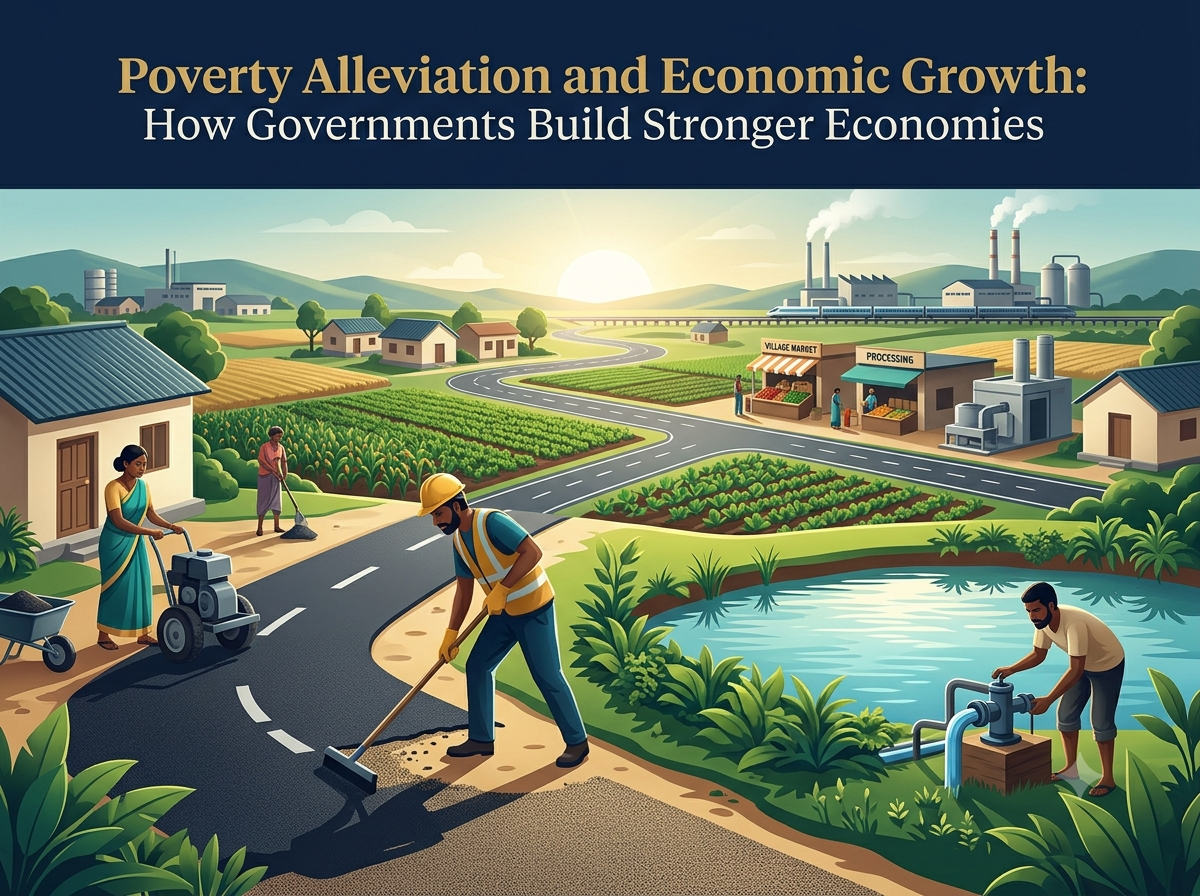
- Constructing village roads.
- Building ponds.
- Improving irrigation facilities.
- Developing water conservation structures.
- Carrying out land improvement activities.
Workers received wages for the work performed.
How Did This Reduce Poverty?
The programme created two important benefits.
First: Employment and income generation.
Rural households received additional employment opportunities, helping them earn wages during periods when agricultural work was unavailable.
Second: Rural infrastructure development.
The work also created useful community assets, such as roads, ponds and irrigation facilities.
Thus, employment generation helped families earn income while contributing to rural development.
Current-status note: MGNREGA was replaced by the VB–G RAM G Act, 2025, effective 1 July 2026. The new framework provides a 125-day employment guarantee per eligible rural household. MGNREGA’s 100-day provision above describes the original programme.
3. What Is Economic Growth?
Economic growth refers to an increase in the production of goods and services in an economy over time.
It is commonly measured through an increase in real Gross Domestic Product (GDP).
When an economy produces more goods and services, it can create additional business opportunities, employment and income.
However, economic growth requires suitable conditions. Governments play an important role in creating these conditions.
Let’s examine three major measures.
4. Government Measures to Promote Economic Growth
A. Investment in Infrastructure
Infrastructure refers to the basic facilities and systems needed for the functioning of an economy.
It includes:
- National highways and roads.
- Modern railway networks.
- Ports and airports.
- Electricity and power grids.
- Digital communication networks.
Imagine a manufacturing company that produces goods but struggles to transport them because the roads are poorly developed.
Transportation becomes expensive, deliveries are delayed and business efficiency suffers.
When governments invest in better roads, railways, electricity and communication systems, businesses can operate more efficiently.
This reduces production and transportation difficulties and supports economic activity.
B. Promoting Industrialisation and Ease of Doing Business
Industrialisation refers to the development and expansion of industries in an economy.
Industries manufacture goods, generate employment and contribute to national production.
Governments encourage industrial development through supportive policies and investment initiatives.
For example, India’s Make in India initiative aims to encourage domestic manufacturing and attract investment.
Other important measures include:
Attracting Foreign Direct Investment (FDI): FDI refers to investment made by individuals or companies from another country in businesses or productive assets. It can bring capital, technology and expertise.
Simplifying business regulations: Making business procedures easier can encourage entrepreneurs to establish and expand businesses.
These measures help promote industrial development and economic activity.
C. Developing Human Capital
Economic growth does not depend only on factories, machines and infrastructure. It also depends on people.
Human capital refers to the knowledge, skills, abilities and health of individuals that contribute to their productivity.
Governments develop human capital through:
Education: Better educational opportunities help people gain knowledge and qualifications.
Skill development: Training programmes prepare individuals for different occupations and industries.
Healthcare: A healthier population is generally better able to participate in productive economic activities.
For example, a skilled worker may operate machinery more efficiently, while a healthy workforce can contribute more effectively to production.
Investment in people therefore supports long-term economic growth.
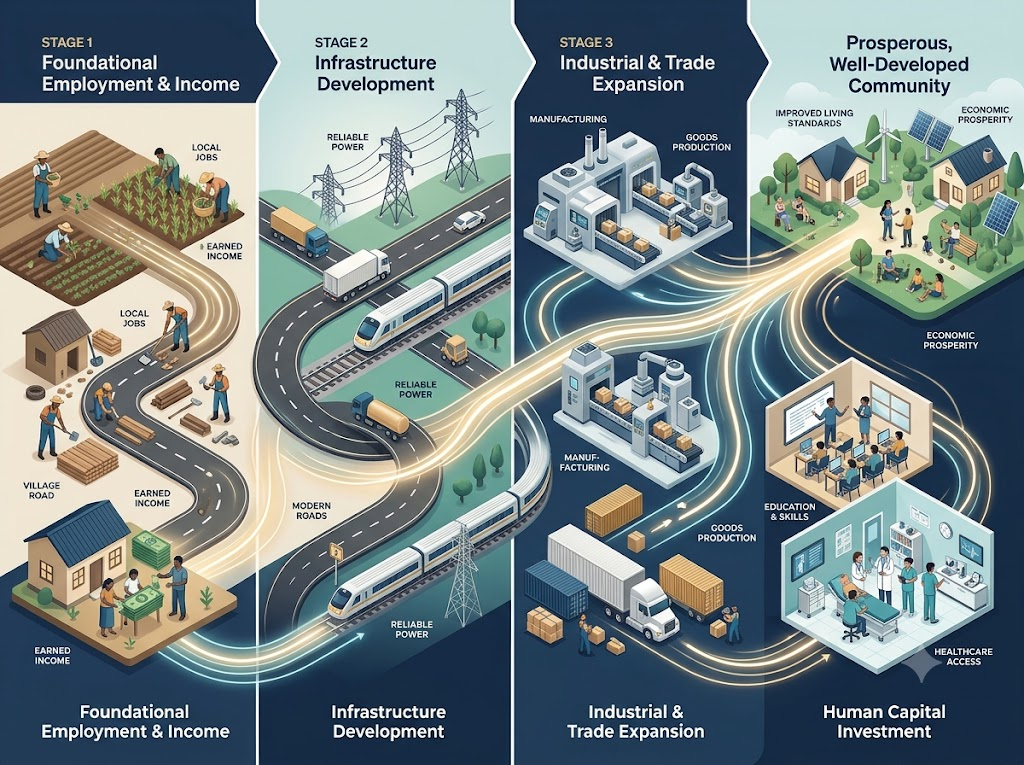
5. How Poverty Alleviation and Economic Growth Work Together
These two objectives are closely connected.
Consider the following relationship:
- Employment programmes provide income opportunities to disadvantaged households.
- Better infrastructure allows businesses to operate more efficiently.
- Growing industries create additional production and employment opportunities.
- Education, skills and healthcare improve workforce productivity.
- Greater employment and productive economic activity can contribute to higher household incomes and poverty reduction.
However, economic growth does not automatically eliminate poverty. Governments must also ensure that opportunities and benefits reach disadvantaged sections of society.
The Final Takeaway
Governments fight poverty through employment and income-generating programmes while promoting economic growth through infrastructure, industrialisation and human capital development.
Remember: Employment helps reduce poverty, while infrastructure, industries and productive people help build a growing economy.