Imagine a business with ₹70,000 in its cash box and ₹80,000 in the bank. The business is moving fast: goods are purchased by cheque, customers pay in cash and by cheque, wages are paid, and the bank adds interest while deducting charges.
Then trouble arrives. Shweta’s cheque is returned dishonoured!
How can the business track all this without confusing cash in hand with money in the bank? The answer is a Bank Column Cash Book.
Two Columns, Two Balances
A Bank Column Cash Book has separate Cash and Bank amount columns on both sides.
- Debit side (Dr.): Records cash received and money entering the bank.
- Credit side (Cr.): Records cash paid and money leaving the bank.
A transfer between cash and bank is called a contra entry. For example, withdrawing ₹12,000 from the bank for office use increases cash in hand and decreases the bank balance.
Bank Column Cash Book
This solution assumes Malti’s payment and the telephone bill were paid in cash, the cheques received were deposited into the bank, and Shweta’s cheque was included in the bank receipts before it was dishonoured.
| Date | Particulars | Cash (₹) | Bank (₹) | Date | Particulars | Cash (₹) | Bank (₹) |
|---|---|---|---|---|---|---|---|
| Dr. — Receipts | Cr. — Payments | ||||||
| — | To Balance b/d | 70,000 | 80,000 | — | By Balance b/d | — | — |
| — | To Sales A/c | 20,000 | — | — | By Purchases A/c | — | 10,000 |
| — | To Sales A/c (cheque) | — | 40,000 | — | By Hari Om A/c | — | 7,000 |
| — | To Malti A/c | 4,000 | — | — | By Telephone Expenses A/c | 2,000 | — |
| — | To Shweta A/c (cheque) | — | 8,000 | — | By Wages A/c | 18,000 | — |
| — | To Bank A/c (withdrawal) | 12,000 | — | — | By Cash A/c (withdrawal) | — | 12,000 |
| — | To Interest A/c | — | 190 | — | By Shweta A/c (dishonoured cheque) | — | 8,000 |
| — | To Sales A/c (cash) | 4,000 | — | — | By Bank Charges A/c | — | 120 |
| — | By Balance c/d | 90,000 | 91,070 | ||||
| Total | 1,10,000 | 1,28,190 | Total | 1,10,000 | 1,28,190 |
The transaction dates were not supplied, so the table does not invent dates. The opening balances appear on the debit side; the bank opening balance is positive, not an overdraft.
Step 1: Find the Closing Cash Balance
The business starts with ₹70,000 in cash.
Cash receipts:
- Cash sales: ₹20,000
- Received from Malti: ₹4,000
- Cash withdrawn from bank: ₹12,000
- Further cash sales: ₹4,000
Total cash available = ₹70,000 + ₹20,000 + ₹4,000 + ₹12,000 + ₹4,000 = ₹1,10,000
Cash payments:
- Telephone bill: ₹2,000
- Wages: ₹18,000
Total cash payments = ₹2,000 + ₹18,000 = ₹20,000
Closing cash balance = ₹1,10,000 − ₹20,000 = ₹90,000
Step 2: Find the Closing Bank Balance
The opening bank balance is ₹80,000.
Bank receipts:
- Cheque received for sales: ₹40,000
- Cheque received from Shweta: ₹8,000
- Interest collected by bank: ₹190
Total bank receipts including opening balance = ₹80,000 + ₹40,000 + ₹8,000 + ₹190 = ₹1,28,190
Bank payments:
- Goods purchased by cheque: ₹10,000
- Paid Hari Om by cheque: ₹7,000
- Withdrawal for office use: ₹12,000
- Shweta’s dishonoured cheque: ₹8,000
- Bank charges: ₹120
Total bank payments = ₹10,000 + ₹7,000 + ₹12,000 + ₹8,000 + ₹120 = ₹37,120
Closing bank balance = ₹1,28,190 − ₹37,120 = ₹91,070
Three Transactions to Watch Carefully
1. Cash withdrawn from the bank: The Cash column is debited by ₹12,000, while the Bank column is credited by ₹12,000. This is a contra entry because money moves between two accounts of the same business.
2. Shweta’s cheque dishonoured: The earlier bank receipt is reversed by crediting the Bank column by ₹8,000. The amount is again due from Shweta.
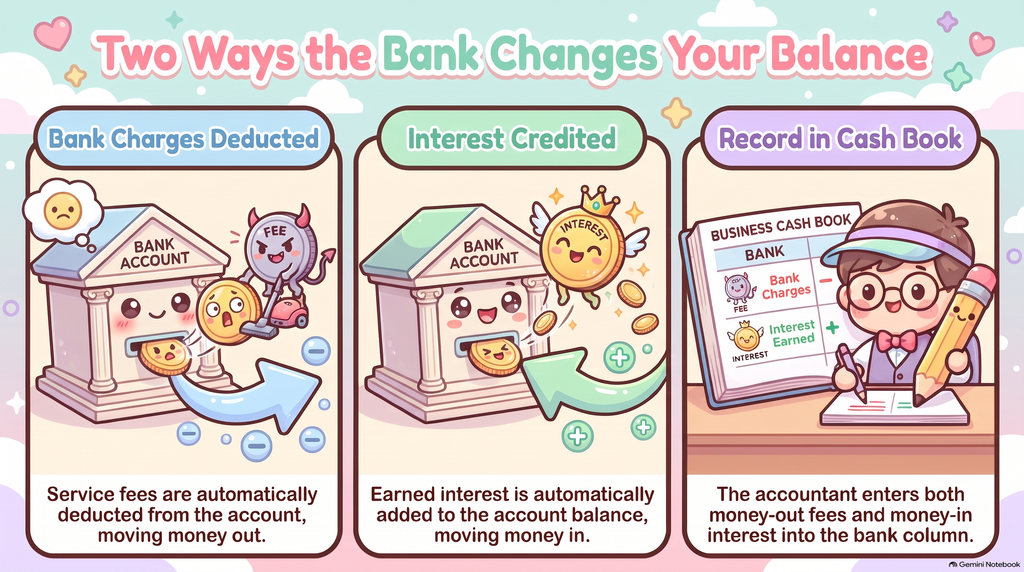
3. Interest and bank charges: Interest of ₹190 increases the bank balance, so it is entered on the debit side in the Bank column. Bank charges of ₹120 reduce the balance, so enter them on the credit side.
Final Answer
At the end of the transactions, the Bank Column Cash Book shows:
- Cash in hand: ₹90,000
- Cash at bank: ₹91,070
Exam memory line: Record receipts on the debit side and payments on the credit side. A bank withdrawal for office use is a contra entry, a dishonoured cheque reverses the earlier bank receipt, and bank interest and charges are recorded according to whether they increase or decrease the bank balance.