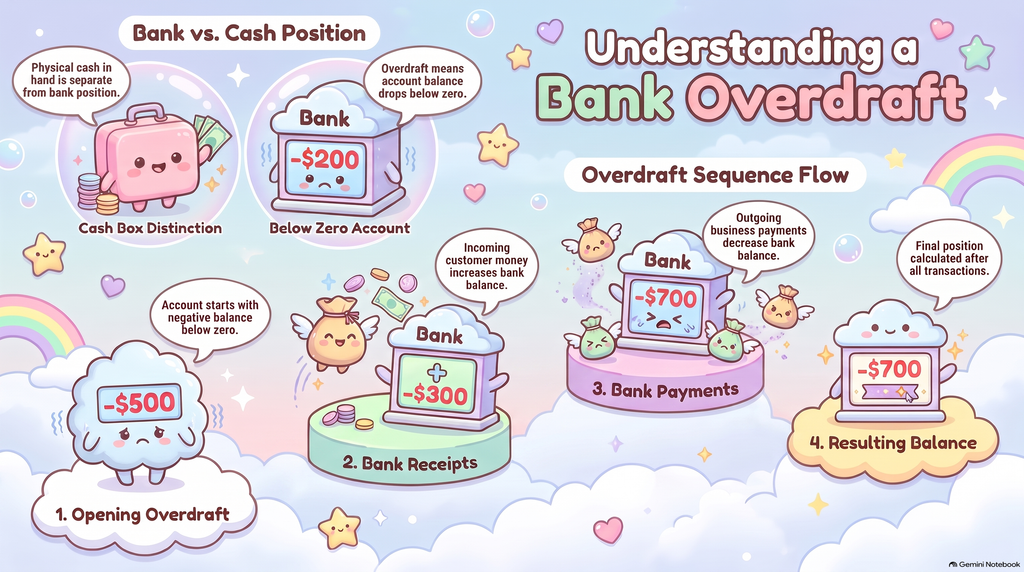
A business can have cash in its cash box and still owe money to the bank. That is exactly the situation facing our business on 1 March 2012: it has ₹2,750 in cash, but its bank account is overdrawn by ₹3,125.
During March, the business receives money, pays expenses, buys goods by cheque and finally deposits its excess cash into the bank. Can it clear the overdraft and finish the month with a positive bank balance?
Let’s prepare the Bank Column Cash Book and find out.
Understanding the Two Columns
A Bank Column Cash Book has two amount columns on both sides:
- Cash column: Records cash received and cash paid.
- Bank column: Records money deposited into the bank and payments made through the bank.
Cash and bank receipts are recorded on the debit side. Cash and bank payments are recorded on the credit side.
An important point: a bank overdraft means the business owes money to the bank. It is therefore entered as an opening credit balance in the bank column.
Bank Column Cash Book of March 2012
The following solution assumes that transactions without a stated payment method—such as the electricity repair payment and the receipts from sales and Sheela—were made in cash. It also assumes Girdhari Lal’s cheque was deposited into the bank. The ₹20 rebate allowed to Sheela is not entered in the cash and bank columns because it is not money received or paid.
| Date | Particulars | Cash (₹) | Bank (₹) | Date | Particulars | Cash (₹) | Bank (₹) |
|---|---|---|---|---|---|---|---|
| Dr. — Receipts | Cr. — Payments | ||||||
| Mar 1 | To Balance b/d | 2,750 | — | Mar 1 | By Balance b/d (Overdraft) | — | 3,125 |
| Mar 12 | To Sales A/c | 1,280 | — | Mar 2 | By Petty Cash A/c | 250 | — |
| Mar 17 | To Sheela A/c | 950 | — | Mar 8 | By Repairs A/c | 350 | — |
| Mar 24 | To Sales A/c | 2,000 | — | Mar 25 | By Purchases A/c | — | 1,700 |
| Mar 24 | To Sales A/c (Cheque) | — | 3,000 | Mar 30 | By Interest on Overdraft A/c | — | 50 |
| Mar 31 | To Cash A/c (Deposit) | — | 5,380 | Mar 31 | By Bank A/c (Deposit) | 5,380 | — |
| Mar 31 | By Balance c/d | 1,000 | 3,505 | ||||
| Total | 6,980 | 8,380 | Total | 6,980 | 8,380 |
On 1 March, the bank column begins with an overdraft of ₹3,125 on the credit side. By the end of March, the bank has a favourable balance of ₹3,505.
Step 1: Calculate the Cash Balance Before the Deposit
The cash available before the final bank deposit is:
Opening cash = ₹2,750
Add cash received:
- Sale of goods: ₹1,280
- Received from Sheela: ₹950
- Cash received from Girdhari Lal: ₹2,000
Total cash available = ₹2,750 + ₹1,280 + ₹950 + ₹2,000 = ₹6,980
Subtract cash payments:
- Petty cashier: ₹250
- Electricity repairs: ₹350
Cash remaining before deposit = ₹6,980 − ₹600 = ₹6,380
Step 2: Deposit Cash Above ₹1,000 into the Bank
The business wants to retain ₹1,000 in hand. Therefore, it deposits the excess cash.
Cash deposited = ₹6,380 − ₹1,000 = ₹5,380
This is a contra entry because the transaction transfers money from cash to bank within the same business.
- Debit the bank column by ₹5,380 because the bank balance increases.
- Credit the cash column by ₹5,380 because cash in hand decreases.
After the deposit, the closing cash balance is ₹1,000.
Step 3: Calculate the Closing Bank Balance
The bank begins with an overdraft of ₹3,125.
Add the cheque received from Girdhari Lal and deposited into the bank: ₹3,000.
Subtract payments made through the bank:
- Goods purchased by cheque: ₹1,700
- Interest charged on overdraft: ₹50
Then add the cash deposited into the bank: ₹5,380.
Closing bank balance = −₹3,125 + ₹3,000 − ₹1,700 − ₹50 + ₹5,380
Closing bank balance = ₹3,505 favourable balance
The overdraft has been cleared, and the business now has money in the bank.
The Final Result
At the end of March 2012, the Bank Column Cash Book shows:
- Closing cash in hand: ₹1,000
- Closing bank balance: ₹3,505
The business has successfully moved from a bank overdraft to a positive bank balance.
Exam memory line: A bank overdraft is an opening credit balance in the bank column. A cash deposit into the bank is a contra entry: debit Bank and credit Cash.